An arc flash is one of the most dangerous electrical hazards a worker can face. In a fraction of a second, temperatures can exceed 35,000°F, vaporizing metal, igniting clothing, and producing blast pressures strong enough to throw a grown adult across a room. It is no exaggeration to say that proper arc flash labeling can be the difference between a worker going home safely and a catastrophic, life-altering injury.
At Dominion Electric, we have spent decades helping contractors, facility managers, and building owners across the Virginia and Maryland region navigate the complexities of electrical safety. In this guide, we break down everything you need to know about arc flash label requirements — from the governing standards to what belongs on each label, which equipment needs them, and how to keep your facility compliant.
What Is an Arc Flash Label?
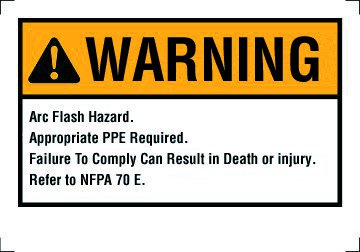
An arc flash label is a safety marking applied to electrical equipment that communicates the potential hazards a worker may encounter when examining, servicing, adjusting, or maintaining that equipment while it is energized. These labels are designed to give qualified electrical workers the critical information they need to select the correct personal protective equipment (PPE) and to understand the boundaries within which a dangerous arc flash event could cause injury.
Arc flash labels are not generic warning stickers. Each label is site-specific, meaning the data it displays is derived from an arc flash study (also called an arc flash hazard analysis) conducted on the actual electrical system where the equipment is installed. Because electrical systems differ from facility to facility — and even from panel to panel within the same building — every label must reflect the real-world conditions of the equipment it is affixed to.
The Standards Behind Arc Flash Labeling
Two primary standards govern arc flash label requirements in the United States: NFPA 70E (Standard for Electrical Safety in the Workplace) and the National Electrical Code (NEC), also known as NFPA 70. OSHA enforces workplace electrical safety outcomes, and compliance with NFPA 70E is widely recognized as the most straightforward path to meeting OSHA regulations under 29 CFR 1910.333(a).
NFPA 70E — Section 130.5(H)
NFPA 70E Section 130.5(H) is the heart of arc flash labeling requirements. This section mandates that electrical equipment likely to require examination, adjustment, servicing, or maintenance while energized must be field-marked with a label containing specific hazard information.
The 2024 edition of NFPA 70E introduced an important addition to this section: labels must now be of sufficient durability for the environment in which they are installed. This means a label in a humid mechanical room, an outdoor switchyard, or a chemical processing facility must be able to withstand those conditions without fading, peeling, or becoming unreadable over time.
NEC Article 110.16
NEC Article 110.16(A) requires general arc flash hazard warning labels on equipment such as switchboards, panelboards, industrial control panels, meter socket enclosures, and motor control centers that are likely to be serviced while energized. Article 110.16(B) goes further, requiring additional labeling for service equipment and feeder disconnects rated 1,200 amps or more that includes the date the label was applied, the available fault current, and the clearing time of the overcurrent protective device.
NEC 110.21(B) also stipulates that all field-applied hazard markings must be durable enough for their given environment. Handwritten markings are generally not permitted unless the information on the label is subject to change.
What Information Must Appear on an Arc Flash Label?
According to NFPA 70E, a compliant arc flash label must contain, at minimum, the following information:
The nominal system voltage tells the worker the electrical potential they are dealing with. The arc flash boundary defines the distance from the equipment at which a worker could receive a second-degree burn if an arc flash occurred without proper PPE. This boundary is measured in feet and inches (or meters), and any person crossing it must be wearing appropriate protective clothing.
The label must also include at least one of three pieces of protective information: the available incident energy expressed in calories per square centimeter (cal/cm²) at a specified working distance, the minimum arc rating of clothing required, or the site-specific level of PPE that must be worn. Many facilities choose to include all three for maximum clarity.
Additionally, shock hazard information is commonly included on arc flash labels, though it is technically covered under separate shock hazard analysis requirements in NFPA 70E. Best practice is to combine both arc flash and shock hazard data on a single label so workers have all relevant safety information in one place.
It is worth noting that older labels using the “Category 0 through 4” hazard risk classification system are no longer considered valid. Since the 2015 update to NFPA 70E, labels must show actual calculated incident energy values or specific PPE requirements rather than broad categories.
Which Equipment Requires Arc Flash Labels?
Not every piece of electrical equipment in a facility needs an arc flash label. The general rule is that labels are required on equipment that is likely to require examination, adjustment, servicing, or maintenance while energized. In practice, this covers a substantial portion of a facility’s electrical infrastructure.
Equipment that typically requires arc flash labels includes switchboards, panelboards, distribution boards, industrial control panels, enclosed circuit breakers, motor control centers, disconnect switches (fused), safety switches (fused), inverters, uninterruptible power supplies (UPS), current transformer cabinets, transformers, external variable frequency drives, and external surge protective devices.
Equipment that generally does not require arc flash labels includes unfused disconnect switches, unfused safety switches, motors, internal meters, lighting control panels, internal surge protective devices, and residential meter sockets.
When in doubt, the safest approach is to label any equipment where a qualified worker might interact with energized conductors or circuit parts. Dominion Electric’s Switchgear and Power Distribution division works with contractors and facility owners every day to help identify which equipment in a given installation warrants labeling — and to ensure the correct products are specified for the job.
Who Is Responsible for Arc Flash Labels?
One of the most commonly misunderstood aspects of arc flash labeling is the question of responsibility. Many facility owners assume their electrical contractor handles labeling, while contractors often assume the owner takes care of it after installation. NFPA 70E makes the answer clear: the owner of the electrical equipment is responsible for the documentation, installation, and maintenance of arc flash labels.
This means that if you own or operate a commercial building, industrial facility, data center, hospital, school, or any other structure with electrical equipment, the labeling obligation falls on you. Even if you rely on outside contractors to perform electrical work, it is your responsibility to ensure that labels are installed, accurate, and kept up to date.
How Often Should Arc Flash Labels Be Updated?
Arc flash labels are not a one-time installation. NFPA 70E recommends that arc flash studies — and therefore the labels that result from them — be reviewed at least every five years. However, an update should occur sooner any time there is a significant change to the electrical system that could affect incident energy levels.
Examples of changes that warrant an immediate review include modifications to transformer sizes, upgrades or changes to protective devices or their settings, additions of new equipment or circuits, changes made by the utility that affect available fault current, and alterations to the configuration of switchgear or distribution systems. Keeping labels current is not just a compliance matter — outdated labels can give workers a false sense of security, leading them to wear insufficient PPE for the actual hazard level present.
Label Durability: A Requirement, Not a Suggestion
The 2024 edition of NFPA 70E elevated label durability from a best practice to an explicit requirement. Labels must remain legible and intact for the life of the equipment or until the next scheduled update, regardless of environmental conditions. This means selecting label materials and adhesives that can withstand exposure to heat, cold, moisture, UV radiation, chemicals, abrasion, and vibration.
A faded or peeling label is effectively the same as no label at all. Workers who cannot read the hazard data on a label are left to guess at the appropriate PPE level, which is exactly the scenario arc flash labeling is designed to prevent.
When sourcing labels and label materials, working with an experienced electrical distributor makes a significant difference. Dominion Electric’s electric supplies division carries a wide range of safety and identification products from leading manufacturers, ensuring you can find materials rated for your specific environment.
The Role of Arc Flash Studies
Arc flash labels do not exist in isolation. They are the visible output of an arc flash study, which is an engineering analysis of your electrical system that calculates the incident energy available at each piece of equipment. The study considers factors such as available fault current, the type and settings of protective devices, conductor lengths and configurations, and equipment design.
Without a proper arc flash study, there is no reliable data to put on a label. Generic or estimated labels do not satisfy NFPA 70E requirements and can expose both workers and facility owners to significant liability. If your facility has never had an arc flash study performed, or if your last study is more than five years old, scheduling one should be a priority.
Penalties for Non-Compliance
OSHA takes arc flash safety seriously. Facilities that fail to comply with labeling requirements can face citations and fines. Under OSHA’s General Duty Clause and the specific electrical safety standards in 29 CFR 1910 Subpart S, employers are required to protect workers from recognized electrical hazards. Because NFPA 70E is the recognized industry consensus standard for electrical safety, failure to follow its labeling requirements is a straightforward path to an OSHA violation.
Beyond regulatory fines, the human and financial cost of an arc flash incident — including medical expenses, lost productivity, workers’ compensation claims, legal liability, and potential criminal charges — far exceeds the cost of a comprehensive labeling program.
Getting Started with Arc Flash Compliance
If your facility needs new arc flash labels, updated labels, or an initial arc flash study, the first step is to partner with professionals who understand both the standards and the practical realities of electrical systems. Dominion Electric has been serving electrical contractors, facility managers, and building owners across the DC metropolitan area since 1940, and our team brings deep expertise in custom electrical solutions for commercial, industrial, and institutional environments.
Whether you need help identifying which equipment requires labeling, sourcing durable label materials for a harsh environment, or specifying the right switchgear and protective devices to reduce incident energy levels, our knowledgeable staff is ready to support your project from start to finish.
Arc flash label compliance is not just about avoiding fines — it is about protecting the people who keep your facility running. Take the time to get it right, and make sure every label on every panel tells the truth about the hazard behind the door.
Dominion Electric Supply is a trusted electrical distributor serving Virginia, Maryland, and the greater Washington, D.C. area. Contact us to learn how our team can support your next project.
 Spanish
  English