Every electrician has met the box that ended up too deep after the drywall went on, or the one so packed with splices the device will not seat. An electrical box extension ring fixes both problems in minutes, without cutting the box out of the wall.
It is one of the cheapest parts on the job, but choosing the wrong size or skipping the code checks can still fail an inspection. Here is how extension rings work, which sizes to stock, and the NEC rules that apply.
What Is an Electrical Box Extension Ring?
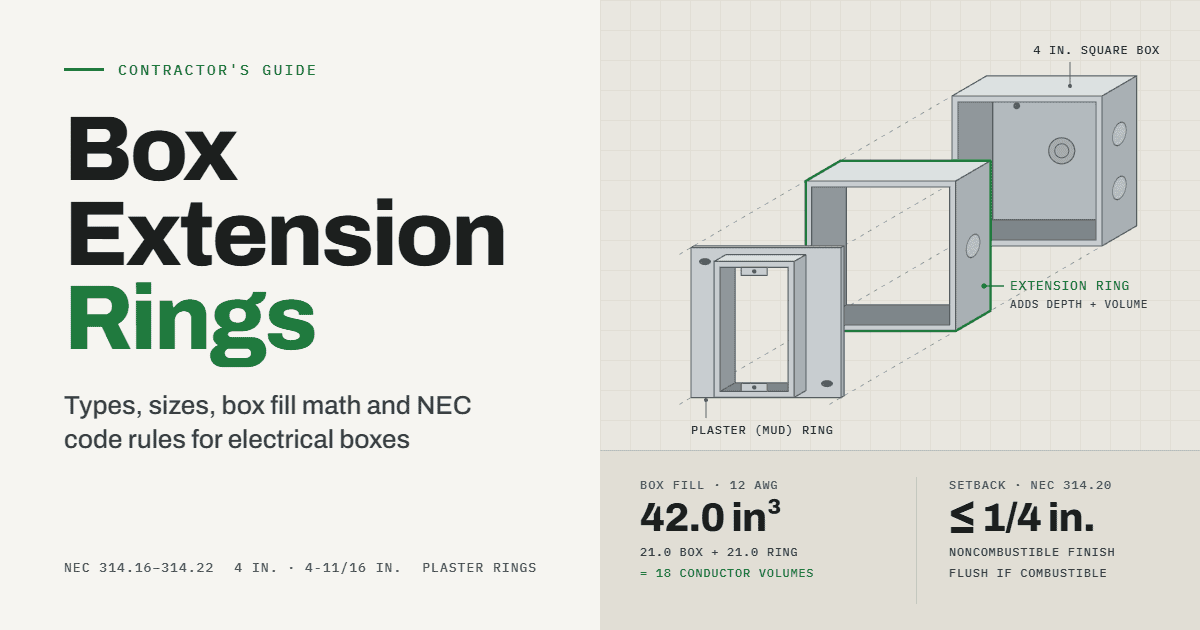
An extension ring is an open steel collar that matches the footprint of an existing box and screws onto its front. It adds depth and interior volume while keeping the full opening, so you can still mount a cover, a plaster ring or a device on top.
Most rings have knockouts on their sides, so they can also take new conduit or cable entries. That makes them handy when a remodel needs one more circuit pulled through an existing box.
Common Extension Ring Types and Sizes
- 4 in. square (1900) extension rings: the workhorse. “1900 box” is the trade name for a 4 in. square box, from an old catalog number, not a volume. A typical 1-1/2 in. deep ring of this size is marked 21 cubic inches.
- 4-11/16 in. square extension rings: for larger boxes with more conductors, bigger devices or larger knockouts.
- Octagon and round extension rings: for 4 in. octagon boxes feeding lighting fixtures and ceiling devices.
- Single-gang and multi-gang box extenders: adjustable collars that bring a device box forward after tile, paneling or a new backsplash is installed.
Square rings must match the box they sit on, since a 4 in. ring will not fit a 4-11/16 in. box. Browse our square box extension rings by size, depth and knockout pattern.
Extension Ring vs. Plaster Ring
The two are easy to mix up on a material list, but they do different jobs.
An extension ring keeps the box’s full square opening and adds depth. A plaster ring, also called a mud ring, reduces a square box opening to a single-gang or two-gang device opening. It also sets the front edge to the thickness of the wall finish, such as 1/2 in. or 5/8 in. drywall.
Many commercial jobs use both: the box, an extension ring for extra volume, then a square box plaster ring on top to finish flush with the wall.
Three Jobs an Extension Ring Does
1. Brings a recessed box to the finished surface. Under NEC 314.20, a box in a noncombustible wall, such as drywall or plaster, can sit no more than 1/4 in. back from the finished surface. In a combustible surface, such as wood paneling, it must be flush or project out. An extension ring or listed box extender closes that gap. Separately, 314.21 requires repairing any gap wider than 1/8 in. around the edge of a flush box.
2. Adds box fill volume. NEC 314.16(A) lets you count the volume of an extension ring when it is marked with its cubic inches. Here is the math on a common case. A 4 in. square, 1-1/2 in. deep box holds 21.0 cubic inches. Each 12 AWG conductor needs 2.25 cubic inches, so the box alone allows nine conductor volumes before you count devices, clamps and grounds. Add a ring marked 21 cubic inches and the assembly holds 42.0 cubic inches, enough for 18.
Physical space still matters beyond the calculation. Oversized splices crowd a box fast, and our wire nuts guide covers matching connectors to conductor size and count.
3. Creates a surface extension. When you extend wiring out of a flush box with a surface method such as EMT or surface raceway, NEC 314.22 requires an extension ring mounted and mechanically secured over the box. A narrow exception allows some extensions from the box cover, but the ring is the standard method.
Installation Tips
- Match brand and size. Screw holes and ears line up best when the ring and box come from the same family.
- Use the marked volume. Take the cubic inches stamped on the ring for your fill calculation, rather than estimating from its depth.
- Secure it properly. Fasten the ring to the box with the screws provided so the assembly is mechanically tight.
- Close unused openings. Any knockout you remove and do not use must be closed, per NEC 110.12(A).
- Plan the finish first. Know the wall finish thickness before you order, so the ring and plaster ring together land within 1/4 in. of the surface.
The Bottom Line
An electrical box extension ring solves three everyday problems: boxes set too deep, boxes that are too full, and surface extensions off an existing box. Pick the ring that matches the box, use its marked volume in your fill math, and check the setback rules before the wall is finished.
Dominion Electric Supply stocks 4 in. square, 4-11/16 in. square and octagon extension rings, plaster rings and box extenders at branches across Virginia, Maryland and Washington, DC. Talk to your local counter team for help matching rings to the boxes on your job.
 Spanish
 English