Not every circuit can go inside the wall. Plaster, block, concrete and historic interiors make fishing wire slow or impossible. That is where surface mount conduit earns its place. It lets you add receptacles, data drops and controls on top of the finished surface, with no demolition and far less patching.
For contractors working tenant fit-outs, school upgrades and office refreshes across Virginia, Maryland and Washington, DC, surface raceway is one of the fastest ways to add capacity to an occupied building. Here is what to know before you spec one.
What Is Surface Mount Conduit?
“Surface mount conduit” is the trade’s everyday name for surface raceway: an enclosed channel fastened to a wall, ceiling or floor that protects and routes conductors. Unlike EMT or rigid conduit, most surface raceway is built as a base and a snap-on cover, so you lay the wire in rather than pulling it through.
The NEC treats it as its own wiring method. Article 386 covers surface metal raceways, and Article 388 covers surface nonmetallic raceways. If you are weighing it against traditional pipe, our guide to electrical conduit types walks through EMT, rigid, PVC and flex side by side.
Metal vs. Nonmetallic Surface Raceway
Metal raceway is usually steel or aluminum. It stands up better to impact, has a more commercial finish, and is the default where an owner or jurisdiction calls for all-steel construction. Steel raceway can also be field-painted to blend into the wall.
Nonmetallic raceway, typically PVC, is lighter, cheaper and quicker to cut. It suits dry, low-traffic areas such as offices, classrooms and data closets. It cannot be used where the ambient temperature exceeds its listed rating, so keep it away from boiler rooms and hot ceiling spaces.
As a rule of thumb, choose metal anywhere carts or chairs will hit the wall, and nonmetallic for light-duty runs.
Common Raceway Sizes and Series
Size the raceway to the conductors and devices it must carry. Wiremold, Legrand’s surface raceway line, is the name most contractors know, and its range covers three broad tiers:
- Small one-piece raceway (500 and 700 series): a low-profile steel channel for extending a single circuit or adding a switch or receptacle.
- Mid-size two-piece raceway: more interior room, with devices mounted along the run instead of in separate boxes.
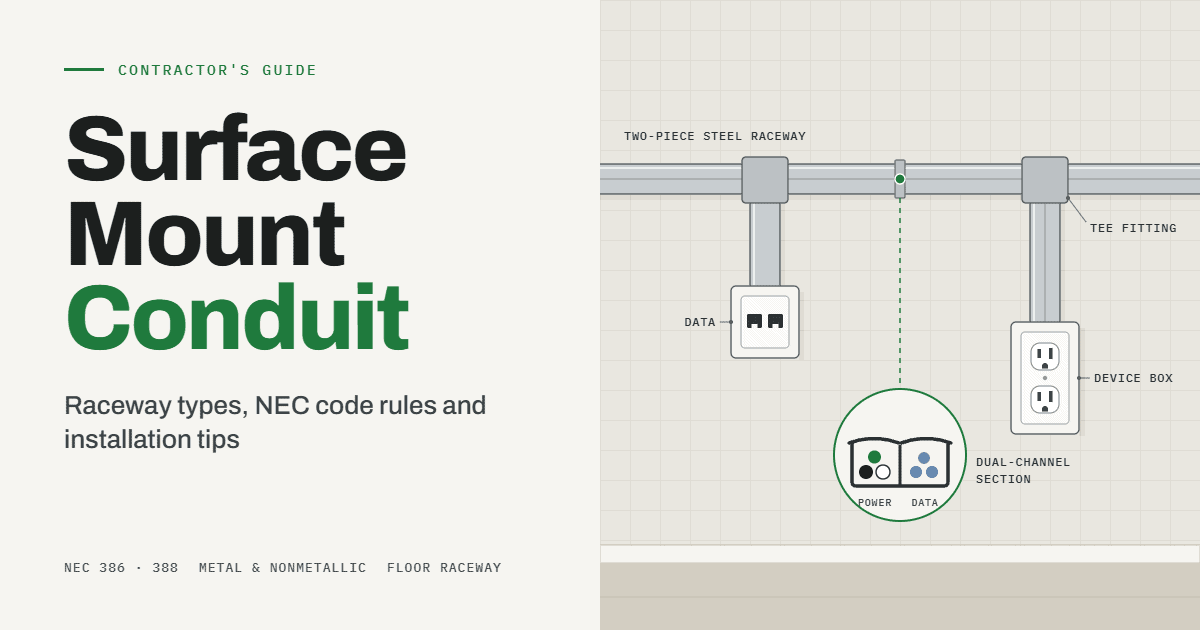
- Large multi-channel raceway (4000 series): two-piece steel with a divider, so power and data can share one run while staying fully separated.
Each series has its own matching elbows, tees, entrance ends and device boxes. Browse our full range of surface raceways and accessories to match fittings to the series you install.
Code Points to Check Before You Install
Surface raceway is simple to install, but the code limits are specific. Under NEC Articles 386 and 388:
- Location: use it for exposed work in dry locations. It is not permitted where subject to severe physical damage (unless approved for that use), in hoistways, where corrosive vapors are present, or in most hazardous locations.
- Voltage: where the voltage is 300 volts or more between conductors, metal raceway must be at least 0.040 in. thick.
- Fill: never exceed the number of conductors the raceway is designed for. Ampacity adjustment factors can be skipped only when the raceway’s cross-section exceeds 4 square inches, it holds no more than 30 current-carrying conductors, and those conductors fill no more than 20% of the interior.
- Splices and taps: allowed only where the cover stays accessible after installation, and fill at that point cannot exceed 75%.
Always check the manufacturer’s fill charts and confirm with the local inspector. Virginia, Maryland and DC each adopt NEC editions on their own schedules and add local amendments.
Bringing Power to the Middle of the Room
Wall raceway handles the perimeter. Open-plan offices and classrooms often need power at desks in the middle of the floor, where coring a slab is disruptive and expensive.
On-floor raceway solves this. Legrand Connectrac runs along the floor or under carpet from the wall to the furniture, with no trenching. Legrand also makes transition fittings that join 4000 series wall raceway to Connectrac, so one continuous system carries power and data from the wall to the workstation. For a quick install, the Connectrac EXPRESS under-carpet kit comes pre-wired with 25 feet of single-circuit conduit, a quad receptacle and a data device.
Installation Tips From the Counter
- Lay out devices first. Mark every receptacle, switch and data outlet, then plan the run between them. It cuts waste and avoids extra fittings.
- Use the system’s own fittings. Factory elbows and tees keep the listing intact and hold the bend radius that data cable needs. Field-cut joints look rough and can raise questions at inspection.
- Keep power and low voltage apart. Use a divided raceway or separate runs to keep communications cabling away from power conductors.
- Order the whole system at once. Covers, couplings, entrance ends and device boxes are series-specific, and a mixed-up order can stall a job.
The Bottom Line
Surface mount conduit adds circuits and data without opening walls or floors. Match the material to the environment, size for today’s load plus growth, and stay inside the Article 386 and 388 limits.
Dominion Electric Supply stocks Wiremold surface raceway, Connectrac floor systems and the fittings that go with them at branches across Virginia, Maryland and Washington, DC. Talk to your local counter team for help with takeoffs, fill calculations and product selection.
 Spanish
 English